besides glucose what other kinds of molecules can be used to produce atp in cellular respiration
Identify the reactants and products of cellular respiration and where these reactions occur in a jail cell
Now that nosotros've learned how autotrophs like plants catechumen sunlight to sugars, allow's have a wait at how all eukaryotes—which includes humans!—brand employ of those sugars.
In the process of photosynthesis, plants and other photosynthetic producers create glucose, which stores energy in its chemical bonds. And so, both plants and consumers, such as animals, undergo a series of metabolic pathways—collectively chosen cellular respiration. Cellular respiration extracts the energy from the bonds in glucose and converts it into a form that all living things can use.
Learning Objectives
- Describe the procedure of glycolysis and identify its reactants and products
- Describe the process of pyruvate oxidation and identify its reactants and products
- Describe the process of the citric acid bike (Krebs cycle) and identify its reactants and products
- Describe the respiratory chain (electron transport chain) and its role in cellular respiration
Cellular respiration is a procedure that all living things utilize to catechumen glucose into energy. Autotrophs (like plants) produce glucose during photosynthesis. Heterotrophs (like humans) ingest other living things to obtain glucose. While the process can seem complex, this folio takes you through the key elements of each part of cellular respiration.
Glycolysis
Glycolysis is the beginning step in the breakdown of glucose to extract energy for cellular metabolism. About all living organisms carry out glycolysis as part of their metabolism. The procedure does non use oxygen and is therefore anaerobic (processes that apply oxygen are chosen aerobic). Glycolysis takes place in the cytoplasm of both prokaryotic and eukaryotic cells. Glucose enters heterotrophic cells in two means.
- Through secondary active transport in which the transport takes place confronting the glucose concentration gradient.
- Through a grouping of integral proteins called Glut proteins, also known as glucose transporter proteins. These transporters assistance in the facilitated improvidence of glucose.
Glycolysis begins with the half-dozen carbon ring-shaped structure of a unmarried glucose molecule and ends with two molecules of a three-carbon sugar calledpyruvate(Effigy 1).

Effigy 1. Reactants and products of glycolysis.
Glycolysis consists of ten steps divided into two singled-out halves. The commencement half of the glycolysis is too known equally the energy-requiring steps. This pathway traps the glucose molecule in the jail cell and uses free energy to modify information technology then that the vi-carbon sugar molecule can be separate evenly into the two three-carbon molecules. The second one-half of glycolysis (also known equally the energy-releasing steps) extracts energy from the molecules and stores it in the form of ATP and NADH, the reduced grade of NAD.
First Half of Glycolysis (Energy-Requiring Steps)

Figure two. The start half of glycolysis uses two ATP molecules in the phosphorylation of glucose, which is so split into two three-carbon molecules.
Step 1. The start footstep in glycolysis is catalyzed by hexokinase, an enzyme with broad specificity that catalyzes the phosphorylation of six-carbon sugars. Hexokinase phosphorylates glucose using ATP as the source of the phosphate, producing glucose-6-phosphate, a more reactive course of glucose. This reaction prevents the phosphorylated glucose molecule from continuing to collaborate with the Overabundance proteins, and it tin can no longer leave the prison cell because the negatively charged phosphate will not allow it to cross the hydrophobic interior of the plasma membrane.
Stride two. In the second step of glycolysis, an isomerase converts glucose-six-phosphate into 1 of its isomers, fructose-6-phosphate. Anisomerase is an enzyme that catalyzes the conversion of a molecule into i of its isomers. This modify from phosphoglucose to phosphofructose allows the eventual carve up of the sugar into two 3-carbon molecules.
Step three. The 3rd step is the phosphorylation of fructose-6-phosphate, catalyzed by the enzyme phosphofructokinase. A second ATP molecule donates a high-energy phosphate to fructose-half-dozen-phosphate, producing fructose-one,6-bisphosphate. In this pathway, phosphofructokinase is a rate-limiting enzyme. It is active when the concentration of ADP is high; it is less active when ADP levels are low and the concentration of ATP is loftier. Thus, if there is "sufficient" ATP in the system, the pathway slows down. This is a blazon of end product inhibition, since ATP is the end product of glucose catabolism.
Step 4. The newly added high-energy phosphates further destabilize fructose-1,vi-bisphosphate. The fourth stride in glycolysis employs an enzyme, aldolase, to cleave 1,half-dozen-bisphosphate into 2 three-carbon isomers: dihydroxyacetone-phosphate and glyceraldehyde-three-phosphate.
Step 5. In the fifth footstep, an isomerase transforms the dihydroxyacetone-phosphate into its isomer, glyceraldehyde-three-phosphate. Thus, the pathway volition continue with two molecules of a single isomer. At this point in the pathway, there is a cyberspace investment of energy from 2 ATP molecules in the breakup of i glucose molecule.
2d Half of Glycolysis (Energy-Releasing Steps)
So far, glycolysis has cost the prison cell two ATP molecules and produced two small, three-carbon sugar molecules. Both of these molecules will proceed through the second half of the pathway, and sufficient energy volition be extracted to pay back the two ATP molecules used every bit an initial investment and produce a turn a profit for the cell of 2 additional ATP molecules and two even higher-energy NADH molecules.

Figure 3. The second one-half of glycolysis involves phosphorylation without ATP investment (pace 6) and produces two NADH and four ATP molecules per glucose.
Step half-dozen. The sixth pace in glycolysis (Figure 3) oxidizes the carbohydrate (glyceraldehyde-3-phosphate), extracting high-energy electrons, which are picked up by the electron carrier NAD+, producing NADH. The sugar is then phosphorylated by the addition of a second phosphate group, producing 1,3-bisphosphoglycerate. Note that the 2nd phosphate grouping does not crave another ATP molecule.
Here once more is a potential limiting factor for this pathway. The continuation of the reaction depends upon the availability of the oxidized form of the electron carrier, NAD+. Thus, NADH must be continuously oxidized back into NAD+ in order to go along this step going. If NAD+ is not available, the second half of glycolysis slows downwards or stops. If oxygen is bachelor in the system, the NADH will exist oxidized readily, though indirectly, and the high-energy electrons from the hydrogen released in this process will exist used to produce ATP. In an environment without oxygen, an alternate pathway (fermentation) can provide the oxidation of NADH to NAD+.
Step seven. In the seventh stride, catalyzed by phosphoglycerate kinase (an enzyme named for the reverse reaction), ane,3-bisphosphoglycerate donates a high-free energy phosphate to ADP, forming one molecule of ATP. (This is an instance of substrate-level phosphorylation.) A carbonyl group on the ane,3-bisphosphoglycerate is oxidized to a carboxyl grouping, and three-phosphoglycerate is formed.
Step 8. In the eighth step, the remaining phosphate group in 3-phosphoglycerate moves from the tertiary carbon to the second carbon, producing two-phosphoglycerate (an isomer of 3-phosphoglycerate). The enzyme catalyzing this footstep is a mutase (a type of isomerase).
Pace 9. Enolase catalyzes the ninth step. This enzyme causes 2-phosphoglycerate to lose h2o from its structure; this is a dehydration reaction, resulting in the formation of a double bond that increases the potential energy in the remaining phosphate bond and produces phosphoenolpyruvate (PEP).
Step 10. The final stride in glycolysis is catalyzed by the enzyme pyruvate kinase (the enzyme in this case is named for the opposite reaction of pyruvate's conversion into PEP) and results in the product of a 2nd ATP molecule by substrate-level phosphorylation and the chemical compound pyruvic acid (or its salt grade, pyruvate). Many enzymes in enzymatic pathways are named for the reverse reactions, since the enzyme tin can catalyze both forward and reverse reactions.
Outcomes of Glycolysis
Glycolysis starts with glucose and ends with two pyruvate molecules, a full of 4 ATP molecules and ii molecules of NADH. Two ATP molecules were used in the first half of the pathway to prepare the half-dozen-carbon ring for cleavage, so the prison cell has a internet gain of ii ATP molecules and two NADH molecules for its utilise.
If the prison cell cannot catabolize the pyruvate molecules farther, it will harvest simply 2 ATP molecules from one molecule of glucose. Mature mammalian red blood cells are non capable ofaerobic respiration—the procedure in which organisms catechumen free energy in the presence of oxygen—and glycolysis is their sole source of ATP. If glycolysis is interrupted, these cells lose their ability to maintain their sodium-potassium pumps, and somewhen, they die.
The last footstep in glycolysis will not occur if pyruvate kinase, the enzyme that catalyzes the formation of pyruvate, is non available in sufficient quantities. In this state of affairs, the entire glycolysis pathway will proceed, but but two ATP molecules will be made in the second half. Thus, pyruvate kinase is a charge per unit-limiting enzyme for glycolysis.
In Summary: Glycolysis
Glycolysis is the first pathway used in the breakdown of glucose to extract free energy. It was probably one of the earliest metabolic pathways to evolve and is used by nearly all of the organisms on earth. Glycolysis consists of ii parts: The get-go role prepares the vi-carbon ring of glucose for cleavage into two three-carbon sugars. ATP is invested in the process during this half to energize the separation. The second half of glycolysis extracts ATP and high-energy electrons from hydrogen atoms and attaches them to NAD+. Two ATP molecules are invested in the first half and 4 ATP molecules are formed by substrate phosphorylation during the 2nd one-half. This produces a net proceeds of 2 ATP and two NADH molecules for the cell.
Figure iv shows the entire procedure of glycolysis in one image:
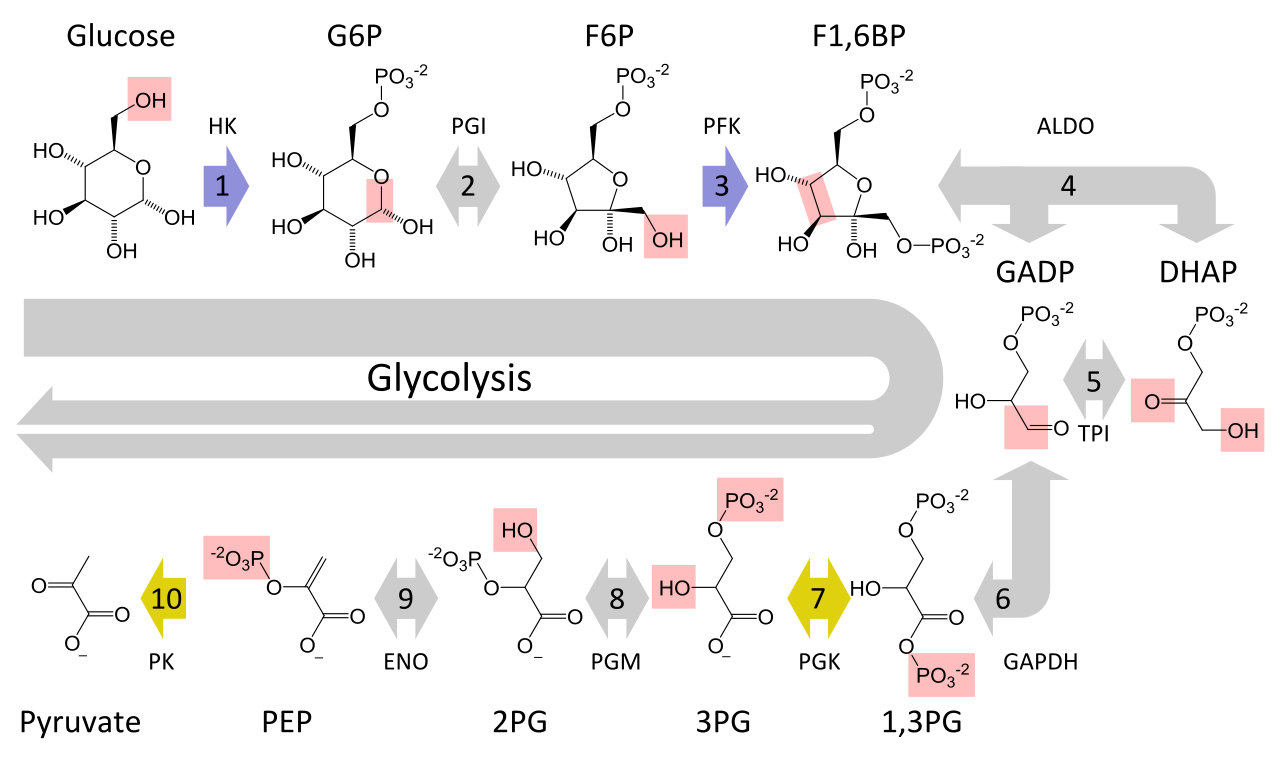
Figure 4. Glycolysis
Pyruvate Oxidation
If oxygen is available, aerobic respiration will go forward. In eukaryotic cells, the pyruvate molecules produced at the end of glycolysis are transported into mitochondria, which are the sites of cellular respiration. There, pyruvate will exist transformed into an acetyl group that will be picked up and activated by a carrier chemical compound chosen coenzyme A (CoA). The resulting chemical compound is called acetyl CoA. CoA is fabricated from vitamin B5, pantothenic acid. Acetyl CoA can be used in a variety of ways past the jail cell, just its major role is to deliver the acetyl group derived from pyruvate to the next stage of the pathway in glucose catabolism.
Breakdown of Pyruvate
In order for pyruvate (which is the product of glycolysis) to enter the Citric Acrid Wheel (the next pathway in cellular respiration), it must undergo several changes. The conversion is a iii-step process (Figure 5).

Figure v. Upon entering the mitochondrial matrix, a multi-enzyme circuitous converts pyruvate into acetyl CoA. In the process, carbon dioxide is released and ane molecule of NADH is formed.
Pace 1. A carboxyl group is removed from pyruvate, releasing a molecule of carbon dioxide into the surrounding medium. The result of this pace is a ii-carbon hydroxyethyl group spring to the enzyme (pyruvate dehydrogenase). This is the first of the half-dozen carbons from the original glucose molecule to be removed. This step proceeds twice (recall: at that place are 2 pyruvate molecules produced at the finish of glycolysis) for every molecule of glucose metabolized; thus, ii of the six carbons volition accept been removed at the end of both steps.
Stride 2. NAD+ is reduced to NADH. The hydroxyethyl grouping is oxidized to an acetyl group, and the electrons are picked upwardly by NAD+, forming NADH. The high-energy electrons from NADH will be used later to generate ATP.
Step 3. An acetyl group is transferred to conenzyme A, resulting in acetyl CoA. The enzyme-spring acetyl group is transferred to CoA, producing a molecule of acetyl CoA.
Notation that during the second stage of glucose metabolism, whenever a carbon atom is removed, it is bound to two oxygen atoms, producing carbon dioxide, one of the major end products of cellular respiration.
Acetyl CoA to COii
In the presence of oxygen, acetyl CoA delivers its acetyl group to a 4-carbon molecule, oxaloacetate, to form citrate, a 6-carbon molecule with 3 carboxyl groups; this pathway volition harvest the remainder of the extractable energy from what began equally a glucose molecule. This single pathway is called by different names, but nosotros volition primarily call it the Citric Acid Cycle.
In Summary: Pyruvate Oxidation
In the presence of oxygen, pyruvate is transformed into an acetyl grouping attached to a carrier molecule of coenzyme A. The resulting acetyl CoA can enter several pathways, but most often, the acetyl group is delivered to the citric acid cycle for further catabolism. During the conversion of pyruvate into the acetyl group, a molecule of carbon dioxide and ii loftier-energy electrons are removed. The carbon dioxide accounts for 2 (conversion of two pyruvate molecules) of the six carbons of the original glucose molecule. The electrons are picked up by NAD+, and the NADH carries the electrons to a later pathway for ATP production. At this point, the glucose molecule that originally entered cellular respiration has been completely oxidized. Chemic potential energy stored within the glucose molecule has been transferred to electron carriers or has been used to synthesize a few ATPs.
Citric Acid Bike
Like the conversion of pyruvate to acetyl CoA, the citric acid cycle takes place in the matrix of mitochondria.This single pathway is called by different names: the citric acid bike (for the commencement intermediate formed—citric acid, or citrate—when acetate joins to the oxaloacetate), the TCA cycle (since citric acid or citrate and isocitrate are tricarboxylic acids), and the Krebs cycle, after Hans Krebs, who first identified the steps in the pathway in the 1930s in pigeon flight muscles.
Almost all of the enzymes of the citric acrid cycle are soluble, with the single exception of the enzyme succinate dehydrogenase, which is embedded in the inner membrane of the mitochondrion. Unlike glycolysis, the citric acid cycle is a closed loop: The concluding part of the pathway regenerates the compound used in the showtime step. The eight steps of the wheel are a series of redox, dehydration, hydration, and decarboxylation reactions that produce two carbon dioxide molecules, one GTP/ATP, and reduced forms of NADH and FADHtwo (Figure 6). This is considered an aerobic pathway because the NADH and FADHii produced must transfer their electrons to the next pathway in the system, which will apply oxygen. If this transfer does not occur, the oxidation steps of the citric acrid cycle also do not occur. Note that the citric acid cycle produces very petty ATP directly and does not directly eat oxygen.

Figure 6. In the citric acid cycle, the acetyl group from acetyl CoA is attached to a four-carbon oxaloacetate molecule to form a vi-carbon citrate molecule. Through a series of steps, citrate is oxidized, releasing two carbon dioxide molecules for each acetyl grouping fed into the cycle. In the process, 3 NAD+ molecules are reduced to NADH, one FAD molecule is reduced to FADH2, and 1 ATP or GTP (depending on the jail cell type) is produced (by substrate-level phosphorylation). Because the terminal product of the citric acid bicycle is as well the first reactant, the cycle runs continuously in the presence of sufficient reactants. (credit: modification of work by "Yikrazuul"/Wikimedia Eatables)
Steps in the Citric Acid Cycle
Step 1. Prior to the kickoff of the first stride, pyruvate oxidation must occur. Then, the first footstep of the cycle begins: This is a condensation step, combining the two-carbon acetyl group with a four-carbon oxaloacetate molecule to course a six-carbon molecule of citrate. CoA is bound to a sulfhydryl grouping (-SH) and diffuses abroad to eventually combine with another acetyl group. This footstep is irreversible because it is highly exergonic. The rate of this reaction is controlled past negative feedback and the amount of ATP bachelor. If ATP levels increase, the rate of this reaction decreases. If ATP is in short supply, the rate increases.
Step 2. In footstep ii, citrate loses i h2o molecule and gains another as citrate is converted into its isomer, isocitrate.
Step three. In step three, isocitrate is oxidized, producing a five-carbon molecule, α-ketoglutarate, together with a molecule of CO2 and two electrons, which reduce NAD+ to NADH. This pace is besides regulated by negative feedback from ATP and NADH, and a positive effect of ADP.
Steps 3 and 4. Steps three and iv are both oxidation and decarboxylation steps, which release electrons that reduce NAD+ to NADH and release carboxyl groups that form COii molecules. α-Ketoglutarate is the production of step iii, and a succinyl group is the product of step four. CoA binds the succinyl grouping to form succinyl CoA. The enzyme that catalyzes step four is regulated by feedback inhibition of ATP, succinyl CoA, and NADH.
Step 5. In step five, a phosphate group is substituted for coenzyme A, and a loftier-energy bond is formed. This energy is used in substrate-level phosphorylation (during the conversion of the succinyl grouping to succinate) to form either guanine triphosphate (GTP) or ATP. There are 2 forms of the enzyme, called isoenzymes, for this step, depending upon the type of animal tissue in which they are found. One form is plant in tissues that apply large amounts of ATP, such as center and skeletal musculus. This grade produces ATP. The second form of the enzyme is found in tissues that have a loftier number of anabolic pathways, such equally liver. This form produces GTP. GTP is energetically equivalent to ATP; withal, its use is more restricted. In particular, poly peptide synthesis primarily uses GTP.
Stride 6. Pace vi is a aridity process that converts succinate into fumarate. Ii hydrogen atoms are transferred to FAD, producing FADHii. The energy contained in the electrons of these atoms is insufficient to reduce NAD+ but adequate to reduce FAD. Different NADH, this carrier remains fastened to the enzyme and transfers the electrons to the electron transport chain directly. This process is fabricated possible by the localization of the enzyme catalyzing this step inside the inner membrane of the mitochondrion.
Footstep seven. Water is added to fumarate during stride vii, and malate is produced. The last stride in the citric acrid cycle regenerates oxaloacetate by oxidizing malate. Some other molecule of NADH is produced in the process.
Products of the Citric Acid Cycle
Two carbon atoms come into the citric acid wheel from each acetyl group, representing four out of the 6 carbons of one glucose molecule. Ii carbon dioxide molecules are released on each plow of the bicycle; however, these do non necessarily comprise the nigh recently added carbon atoms. The 2 acetyl carbon atoms will eventually be released on later turns of the cycle; thus, all six carbon atoms from the original glucose molecule are eventually incorporated into carbon dioxide. Each turn of the cycle forms three NADH molecules and 1 FADHtwo molecule. These carriers volition connect with the final portion of aerobic respiration to produce ATP molecules. Ane GTP or ATP is also made in each bike. Several of the intermediate compounds in the citric acid bicycle tin can be used in synthesizing non-essential amino acids; therefore, the cycle is amphibolic (both catabolic and anabolic).
In Summary: Citric Acrid Cycle
The citric acid cycle is a serial of redox and decarboxylation reactions that remove high-energy electrons and carbon dioxide. The electrons temporarily stored in molecules of NADH and FADH2 are used to generate ATP in a subsequent pathway. 1 molecule of either GTP or ATP is produced past substrate-level phosphorylation on each turn of the wheel. There is no comparison of the cyclic pathway with a linear one.
Electron Transport Chain
Yous have merely read nigh two pathways in cellular respiration—glycolysis and the citric acid bicycle—that generate ATP. Still, most of the ATP generated during the aerobic catabolism of glucose is not generated direct from these pathways. Rather, it is derived from a procedure that begins with moving electrons through a series of electron transporters that undergo redox reactions: the electron transport chain. This causes hydrogen ions to accumulate within the matrix space. Therefore, a concentration gradient forms in which hydrogen ions diffuse out of the matrix space past passing through ATP synthase. The current of hydrogen ions powers the catalytic activeness of ATP synthase, which phosphorylates ADP, producing ATP.
Electron Send Chain
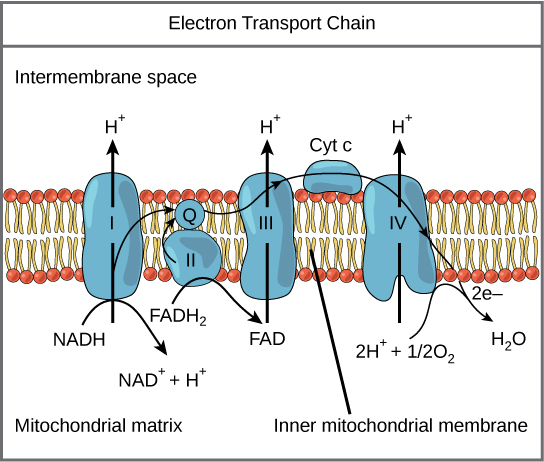
Figure 7. The electron transport concatenation is a series of electron transporters embedded in the inner mitochondrial membrane that shuttles electrons from NADH and FADH2 to molecular oxygen. In the process, protons are pumped from the mitochondrial matrix to the intermembrane space, and oxygen is reduced to form h2o.
The electron transport chain (Figure 7) is the terminal component of aerobic respiration and is the only part of glucose metabolism that uses atmospheric oxygen. Oxygen continuously diffuses into plants; in animals, it enters the body through the respiratory system. Electron ship is a series of redox reactions that resemble a relay race or bucket brigade in that electrons are passed rapidly from one component to the next, to the endpoint of the chain where the electrons reduce molecular oxygen, producing water. There are four complexes composed of proteins, labeled I through IV in Effigy 7, and the aggregation of these four complexes, together with associated mobile, accompaniment electron carriers, is called the electron transport chain. The electron transport chain is present in multiple copies in the inner mitochondrial membrane of eukaryotes and the plasma membrane of prokaryotes. Note, nonetheless, that the electron transport chain of prokaryotes may not crave oxygen as some alive in anaerobic conditions. The common feature of all electron transport chains is the presence of a proton pump to create a proton gradient across a membrane.
Complex I
To start, two electrons are carried to the first complex aboard NADH. This complex, labeled I, is composed of flavin mononucleotide (FMN) and an atomic number 26-sulfur (Fe-Due south)-containing protein. FMN, which is derived from vitamin B2, also called riboflavin, is one of several prosthetic groups or co-factors in the electron transport chain. Aprosthetic grouping is a non-protein molecule required for the activity of a protein. Prosthetic groups are organic or inorganic, not-peptide molecules bound to a poly peptide that facilitate its function; prosthetic groups include co-enzymes, which are the prosthetic groups of enzymes. The enzyme in complex I is NADH dehydrogenase and is a very large protein, containing 45 amino acid chains. Circuitous I tin pump iv hydrogen ions across the membrane from the matrix into the intermembrane space, and it is in this way that the hydrogen ion gradient is established and maintained between the two compartments separated by the inner mitochondrial membrane.
Q and Complex Ii
Circuitous II directly receives FADH2, which does not pass through complex I. The compound connecting the first and second complexes to the third isubiquinone (Q). The Q molecule is lipid soluble and freely moves through the hydrophobic core of the membrane. Once information technology is reduced, (QHtwo), ubiquinone delivers its electrons to the adjacent circuitous in the electron transport concatenation. Q receives the electrons derived from NADH from complex I and the electrons derived from FADHii from circuitous II, including succinate dehydrogenase. This enzyme and FADHii form a pocket-sized complex that delivers electrons directly to the electron transport concatenation, bypassing the offset circuitous. Since these electrons bypass and thus do not energize the proton pump in the first complex, fewer ATP molecules are made from the FADHii electrons. The number of ATP molecules ultimately obtained is directly proportional to the number of protons pumped across the inner mitochondrial membrane.
Complex III
The third complex is equanimous of cytochrome b, another Fe-S protein, Rieske center (2Fe-2S center), and cytochrome c proteins; this complex is also called cytochrome oxidoreductase. Cytochrome proteins have a prosthetic group of heme. The heme molecule is like to the heme in hemoglobin, but it carries electrons, not oxygen. As a result, the iron ion at its core is reduced and oxidized equally information technology passes the electrons, fluctuating betwixt different oxidation states: Fe+ + (reduced) and Fe+ + + (oxidized). The heme molecules in the cytochromes have slightly different characteristics due to the furnishings of the different proteins binding them, giving slightly unlike characteristics to each complex. Complex III pumps protons through the membrane and passes its electrons to cytochrome c for transport to the fourth complex of proteins and enzymes (cytochrome c is the acceptor of electrons from Q; nonetheless, whereas Q carries pairs of electrons, cytochrome c can take only 1 at a time).
Complex Iv
The fourth complex is equanimous of cytochrome proteins c, a, and aiii. This complex contains two heme groups (one in each of the two cytochromes, a, and a3) and three copper ions (a pair of CuA and ane CuB in cytochrome a3). The cytochromes hold an oxygen molecule very tightly between the iron and copper ions until the oxygen is completely reduced. The reduced oxygen so picks up two hydrogen ions from the surrounding medium to make water (HtwoO). The removal of the hydrogen ions from the system contributes to the ion slope used in the process of chemiosmosis.
Chemiosmosis
In chemiosmosis, the free energy from the series of redox reactions just described is used to pump hydrogen ions (protons) across the membrane. The uneven distribution of H+ ions across the membrane establishes both concentration and electrical gradients (thus, an electrochemical gradient), owing to the hydrogen ions' positive accuse and their aggregation on i side of the membrane.
If the membrane were open to diffusion by the hydrogen ions, the ions would tend to diffuse back across into the matrix, driven by their electrochemical gradient. Retrieve that many ions cannot lengthened through the nonpolar regions of phospholipid membranes without the aid of ion channels. Similarly, hydrogen ions in the matrix space can merely pass through the inner mitochondrial membrane through an integral membrane protein chosen ATP synthase (Figure eight). This complex protein acts equally a tiny generator, turned by the force of the hydrogen ions diffusing through information technology, downwardly their electrochemical gradient. The turning of parts of this molecular machine facilitates the improver of a phosphate to ADP, forming ATP, using the potential energy of the hydrogen ion gradient.
Do Question
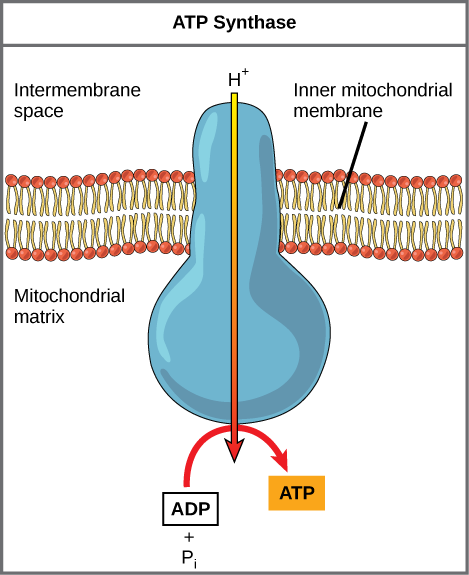
Effigy 8. ATP synthase is a complex, molecular machine that uses a proton (H+) gradient to form ATP from ADP and inorganic phosphate (Pi). (Credit: modification of work by Klaus Hoffmeier)
Dinitrophenol (DNP) is an uncoupler that makes the inner mitochondrial membrane leaky to protons. It was used until 1938 as a weight-loss drug. What upshot would you wait DNP to take on the change in pH across the inner mitochondrial membrane? Why do you think this might be an effective weight-loss drug?
Testify Answer
After DNP poisoning, the electron transport chain can no longer form a proton slope, and ATP synthase can no longer make ATP. DNP is an effective diet drug considering information technology uncouples ATP synthesis; in other words, after taking it, a person obtains less free energy out of the food he or she eats. Interestingly, one of the worst side effects of this drug is hyperthermia, or overheating of the body. Since ATP cannot exist formed, the energy from electron transport is lost as heat.
Chemiosmosis (Figure nine) is used to generate 90 percentage of the ATP made during aerobic glucose catabolism; it is also the method used in the light reactions of photosynthesis to harness the energy of sunlight in the process of photophosphorylation. Recall that the product of ATP using the process of chemiosmosis in mitochondria is called oxidative phosphorylation. The overall result of these reactions is the product of ATP from the energy of the electrons removed from hydrogen atoms. These atoms were originally part of a glucose molecule. At the end of the pathway, the electrons are used to reduce an oxygen molecule to oxygen ions. The extra electrons on the oxygen concenter hydrogen ions (protons) from the surrounding medium, and water is formed.
Do Question
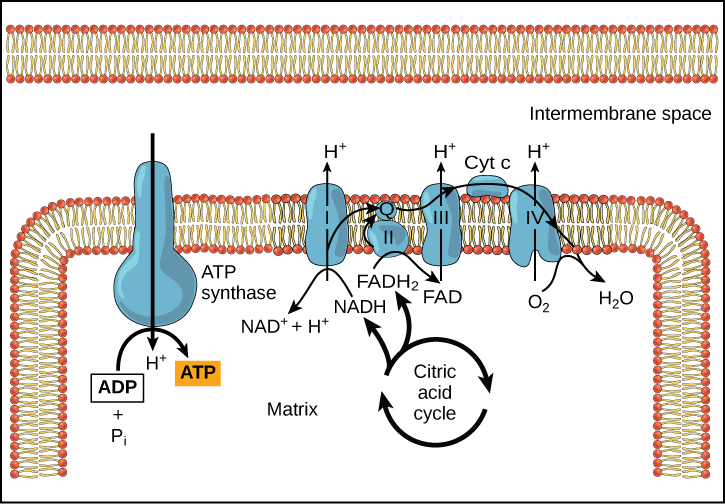
Figure 9. In oxidative phosphorylation, the pH gradient formed by the electron transport concatenation is used by ATP synthase to course ATP.
Cyanide inhibits cytochrome c oxidase, a component of the electron ship chain. If cyanide poisoning occurs, would you look the pH of the intermembrane space to increase or subtract? What effect would cyanide take on ATP synthesis?
Prove Reply
Later cyanide poisoning, the electron ship chain tin no longer pump electrons into the intermembrane space. The pH of the intermembrane space would increase, the pH gradient would subtract, and ATP synthesis would stop.
ATP Yield
The number of ATP molecules generated from the catabolism of glucose varies. For example, the number of hydrogen ions that the electron transport chain complexes can pump through the membrane varies betwixt species. Another source of variance stems from the shuttle of electrons across the membranes of the mitochondria. (The NADH generated from glycolysis cannot easily enter mitochondria.) Thus, electrons are picked upward on the inside of mitochondria by either NAD+ or FAD+. As you have learned earlier, these FAD+ molecules tin can transport fewer ions; consequently, fewer ATP molecules are generated when FAD+ acts every bit a carrier. NAD+ is used equally the electron transporter in the liver and FAD+ acts in the encephalon.
Some other cistron that affects the yield of ATP molecules generated from glucose is the fact that intermediate compounds in these pathways are used for other purposes. Glucose catabolism connects with the pathways that build or break down all other biochemical compounds in cells, and the result is somewhat messier than the ideal situations described thus far. For instance, sugars other than glucose are fed into the glycolytic pathway for energy extraction. Moreover, the five-carbon sugars that form nucleic acids are made from intermediates in glycolysis. Certain nonessential amino acids can be fabricated from intermediates of both glycolysis and the citric acid cycle. Lipids, such as cholesterol and triglycerides, are also made from intermediates in these pathways, and both amino acids and triglycerides are cleaved down for free energy through these pathways. Overall, in living systems, these pathways of glucose catabolism extract well-nigh 34 percent of the free energy contained in glucose.
In Summary: Electron Transport Chain
The electron ship concatenation is the portion of aerobic respiration that uses free oxygen as the last electron acceptor of the electrons removed from the intermediate compounds in glucose catabolism. The electron transport chain is composed of iv big, multiprotein complexes embedded in the inner mitochondrial membrane and two minor diffusible electron carriers shuttling electrons between them. The electrons are passed through a series of redox reactions, with a modest corporeality of free energy used at 3 points to transport hydrogen ions across a membrane. This procedure contributes to the gradient used in chemiosmosis. The electrons passing through the electron transport chain gradually lose energy, High-energy electrons donated to the chain past either NADH or FADHii complete the chain, as low-free energy electrons reduce oxygen molecules and form h2o. The level of free energy of the electrons drops from almost 60 kcal/mol in NADH or 45 kcal/mol in FADH2 to about 0 kcal/mol in water. The end products of the electron transport chain are water and ATP. A number of intermediate compounds of the citric acid cycle can be diverted into the anabolism of other biochemical molecules, such as nonessential amino acids, sugars, and lipids. These same molecules can serve as free energy sources for the glucose pathways.
Let's Review
Cellular respiration is a collection of three unique metabolic pathways: glycolysis, the citric acid cycle, and the electron ship chain. Glycolysis is an anaerobic process, while the other ii pathways are aerobic. In society to move from glycolysis to the citric acid bicycle, pyruvate molecules (the output of glycolysis) must be oxidized in a process called pyruvate oxidation.
Glycolysis
Glycolysis is the first pathway in cellular respiration. This pathway is anaerobic and takes place in the cytoplasm of the cell. This pathway breaks downward 1 glucose molecule and produces 2 pyruvate molecules. There are ii halves of glycolysis, with five steps in each half. The first half is known as the "energy requiring" steps. This half splits glucose, and uses up 2 ATP. If the concentration of pyruvate kinase is loftier enough, the 2d half of glycolysis can continue. In the second half, the "energy releasing: steps, iv molecules of ATP and 2 NADH are released. Glycolysis has a net proceedsof 2 ATP molecules and 2 NADH.
Some cells (e.grand., mature mammalian red claret cells) cannot undergo aerobic respiration, and then glycolysis is their only source of ATP. Even so, most cells undergo pyruvate oxidation and continue to the other pathways of cellular respiration.
Pyruvate Oxidation
In eukaryotes, pyruvate oxidation takes place in the mitochondria. Pyruvate oxidation can merely happen if oxygen is bachelor. In this process, the pyruvate created by glycolysis is oxidized. In this oxidation process, a carboxyl grouping is removed from pyruvate, creating acetyl groups, which compound with coenzyme A (CoA) to form acetyl CoA. This process also releases CO2.
Citric Acid Cycle
The citric acid wheel (also known as the Krebs bike) is the second pathway in cellular respiration, and it also takes place in the mitochondria. The rate of the cycle is controlled by ATP concentration. When in that location is more ATP bachelor, the rate slows downward; when at that place is less ATP the rate increases. This pathway is a closed loop: the final step produces the compound needed for the first stride.
The citric acid cycle is considered an aerobic pathway because the NADH and FADHtwo it produces human action as temporary electron storage compounds, transferring their electrons to the adjacent pathway (electron transport chain), which uses atmospheric oxygen. Each turn of the citric acid cycle provides a net gain of COtwo, 1 GTP or ATP, and 3 NADH and 1 FADH2.
Electron Transport Concatenation
Virtually ATP from glucose is generated in the electron send chain. It is the simply part of cellular respiration that direct consumes oxygen; even so, in some prokaryotes, this is an anaerobic pathway. In eukaryotes, this pathway takes place in the inner mitochondrial membrane. In prokaryotes it occurs in the plasma membrane.
The electron transport chain is made upward of 4 proteins along the membrane and a proton pump. A cofactor shuttles electrons between proteins I–III. If NAD is depleted, skip I: FADH2 starts on II. In chemiosmosis, a proton pump takes hydrogens from within mitochondria to the outside; this spins the "motor" and the phosphate groups attach to that. The motility changes from ADP to ATP, creating 90% of ATP obtained from aerobic glucose catabolism.
Let's Practice
Now that y'all've reviewed cellular respiration, this practice activeness will aid you encounter how well y'all know cellular respiration:
Click here for a text-just version of the activeness.
Check Your Understanding
Reply the question(s) below to see how well you understand the topics covered in the previous section. This short quiz doesnot count toward your class in the class, and you tin can retake it an unlimited number of times.
Utilise this quiz to check your understanding and decide whether to (1) study the previous section farther or (2) move on to the next section.
martinmitersell1936.blogspot.com
Source: https://courses.lumenlearning.com/suny-wmopen-biology1/chapter/cellular-respiration/
0 Response to "besides glucose what other kinds of molecules can be used to produce atp in cellular respiration"
Post a Comment